
You're Using AI Like Google. That's the Problem.
Do You Have a PC with an OS?
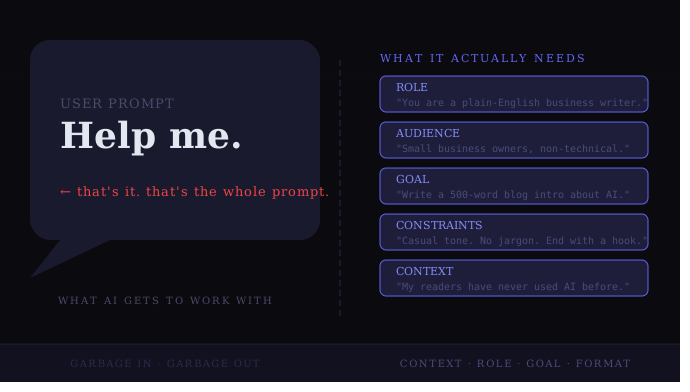
Most people use AI chat the same way they used to use Google — type a question, get an answer, move on. It's a search engine with a better vocabulary.
That's fine. But it's like buying a Ferrari and only ever using it in a parking lot.
The Moment I Got It
Earlier this year I typed something into Claude that changed how I thought about it entirely.
"I'm 50 years old. I want to lose weight but I love pizza, cheeseburgers, and chicken wings. And I never want to be hungry."
That wasn't a Google query. That was a conversation. And what came back wasn't a generic meal plan — it was a strategy built around me. Four months and 40 pounds later, I understood what this thing actually is.
It's not a search engine. It's a coach. And like any good coach, the more it knows about you, the better it performs.
At some point I asked it directly: "How can I use you better?"
That's when it introduced me to two concepts that changed everything.
Your Personal OS
Think of your Operating System like the firmware running underneath everything you do. It's not what you do — it's how you're wired to do it.
Your OS is the document that captures:
- Your values — What are the non-negotiables? What would you never compromise on, no matter the upside?
- How you operate — Are you a morning person? Do you need deep work blocks? Do you make decisions by gut or by data?
- What drains you vs. what energizes you — This one alone is worth the exercise.
- Your risk profile — Are you a calculated risk-taker or do you need a runway before you leap?
- Your relationships and what they mean to you — Who are you protecting? Who are you building for?
Mine has things like: Faith first. Family second. Work third. And: I will only do work I genuinely believe in. That last one has saved me from some bad decisions.
The point isn't to produce a perfect document. The point is the exercise — sitting down and actually answering these questions forces a kind of self-awareness that most people never do intentionally.
Your Personal Compass
If the OS is your firmware, the Personal Compass (PC) is your GPS.
It answers three questions:
- Where have you been? — The career arc, the experiences, the failures that shaped you.
- Where are you right now? — Honest assessment. Not where you want to be. Where you actually are.
- Where do you want to go? — Not just goals. The why behind them.
My compass has things like a 25-year engineering career that started at NASA and eventually landed in enterprise software. It has a youth sports platform I've been building on nights and weekends. And it has a north star moment — handing out sports card books at an end-of-season banquet and watching kids' faces light up.
That moment isn't a business metric. But it's the reason the business exists.
How to Build Yours — The 10-Question Conversation
You don't need to stare at a blank page. Just paste this prompt into your AI chat and let it interview you:
Prompt to build your Personal OS:
"I want to build a Personal Operating System document that captures how I'm wired — my values, how I work best, what energizes and drains me, my risk tolerance, and my non-negotiables. Ask me 10 questions, one at a time, to draw this out. After I answer all 10, compile it into a structured document I can save and reuse."
Prompt to build your Personal Compass:
"I want to build a Personal Compass that captures where I've been, where I am right now, and where I want to go. Ask me 10 questions, one at a time — covering my background, current situation, and future goals. After I answer all 10, compile it into a document I can use in future conversations."
Answer honestly. Don't perform. The chat isn't judging you.
Why It Actually Matters
Once you have these documents, paste them into any new conversation. Now when you ask for advice, you're not getting generic advice — you're getting advice filtered through your context.
Ask it to evaluate a business idea, and it won't just tell you if the market is good. It'll flag if the model conflicts with your need to be risk-managed. It'll remind you that time with family is a stated priority. It'll ask if this moves you toward your north star or pulls you sideways.
That's not a search engine. That's a thinking partner who actually knows you.
The Uncomfortable Part
Here's the thing nobody tells you: the documents are useful, but the real value is what happens when you write them.
Most people have never sat down and articulated their values. Or admitted what actually drains them. Or been honest about where they really are versus where they say they are.
That's the work. The chat just holds the mirror.
The question isn't whether AI can help you. It's whether you're willing to be honest enough with yourself to make it useful.