
AI Guesses. Smart Businesses Verify
And what to do about it when the stakes are high.
Code is boring. In a good way.
When you write code, it's deterministic. Same input, same output. Every time. No surprises.
Think of it like doing the math on a movie night out — 4 tickets, a large popcorn, 4 drinks, a box of candy. You look up the prices, you get an exact total. Done.
AI doesn't work like that.
AI is a very well-read guesser.
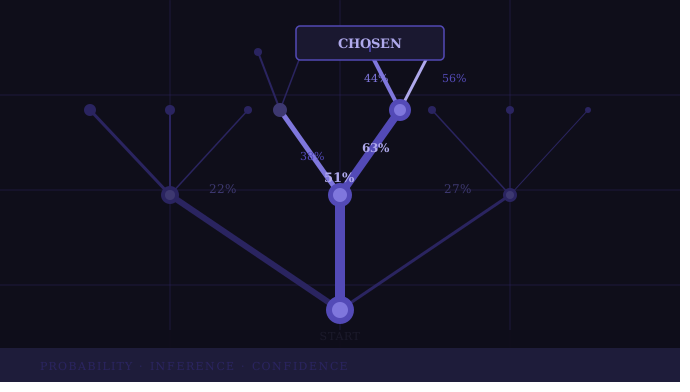
AI is probabilistic — it doesn't calculate an answer, it predicts the most likely one based on everything it's learned. It's a different job entirely.
Back to the movie theater: if you don't know current prices but you know what they were last year, how fast they've been rising, and what the theaters nearby are charging — AI can work with that. It synthesizes the pattern and gives you its best estimate.
The more data it has, the better the guess. But it's always a guess.
The scary part: it doesn't know when it's wrong.
This is where hallucination comes in. When AI doesn't have enough data to actually know something, it doesn't say "I don't know." It gives you its best guess anyway — and does so with full confidence.
It's like asking a kid what the capital of Kazakhstan is. He has no idea, but he's not going to admit that. He'll say "Moscow" like he means it.
This isn't actually that weird.
Most of the critical systems we depend on every day are probabilistic. Jet engines don't come with guarantees — they come with failure rates. Hospitals don't have certainty that the power stays on — they have backup generators. Your grocery store doesn't know the food will be there — it runs on demand forecasts.
We've solved this before. We just need to apply the same playbook to AI.
How you deal with it
1. Check the result.
More reviewers from different perspectives = more accuracy. That reviewer could be a human, a deterministic validation layer, or another AI model comparing outputs from a different angle. And here's a non-obvious thing: how you ask matters. Ask AI why a plan will succeed and ask why it will fail — you'll get very different answers. Use both.
2. Apply safeguards.
Once you know the cost of a bad result, wrap deterministic controls around the danger zone. If AI is buying things on your behalf, add a rule: anything over $500 needs a human to approve it. Simple, boring, effective.
3. Manage the process.
This is the real shift. Just like in any organization, someone has to decide which AIs get hired, which get fired, who gets what work, and what risks are acceptable. That's a human job. It's probably your job — or it will be.
The uncomfortable question nobody's quite answered yet: if the AI managing other AIs is itself probabilistic — who's checking that one?